










If you’re gluing pressed flowers, use thin PVA for most flat paper projects and use tacky glue for small, firm contact points on thicker blooms. That’s the short answer.
I’d sum it up like this:
- PVA glue is better for delicate petals, cards, framed pieces, and resin prep
- Tacky glue is better for thicker stems, layered flowers, and tiny spot gluing
- The main risk with PVA is too much moisture
- The main risk with tacky glue is visible lumps, ridges, or wet spots
- For long-term display, neutral-pH, acid-free glue can help slow yellowing and browning over time
A few points matter most when I compare them:
- Hold strength
- Dry finish
- Control during placement
- Cleanup
- risk of petal damage
Best rule to follow: put glue on the backing surface, not straight on the flower. Then place the flower with fine tweezers and use only a small amount. For resin work, let flowers and glue dry fully, often overnight, before pouring.
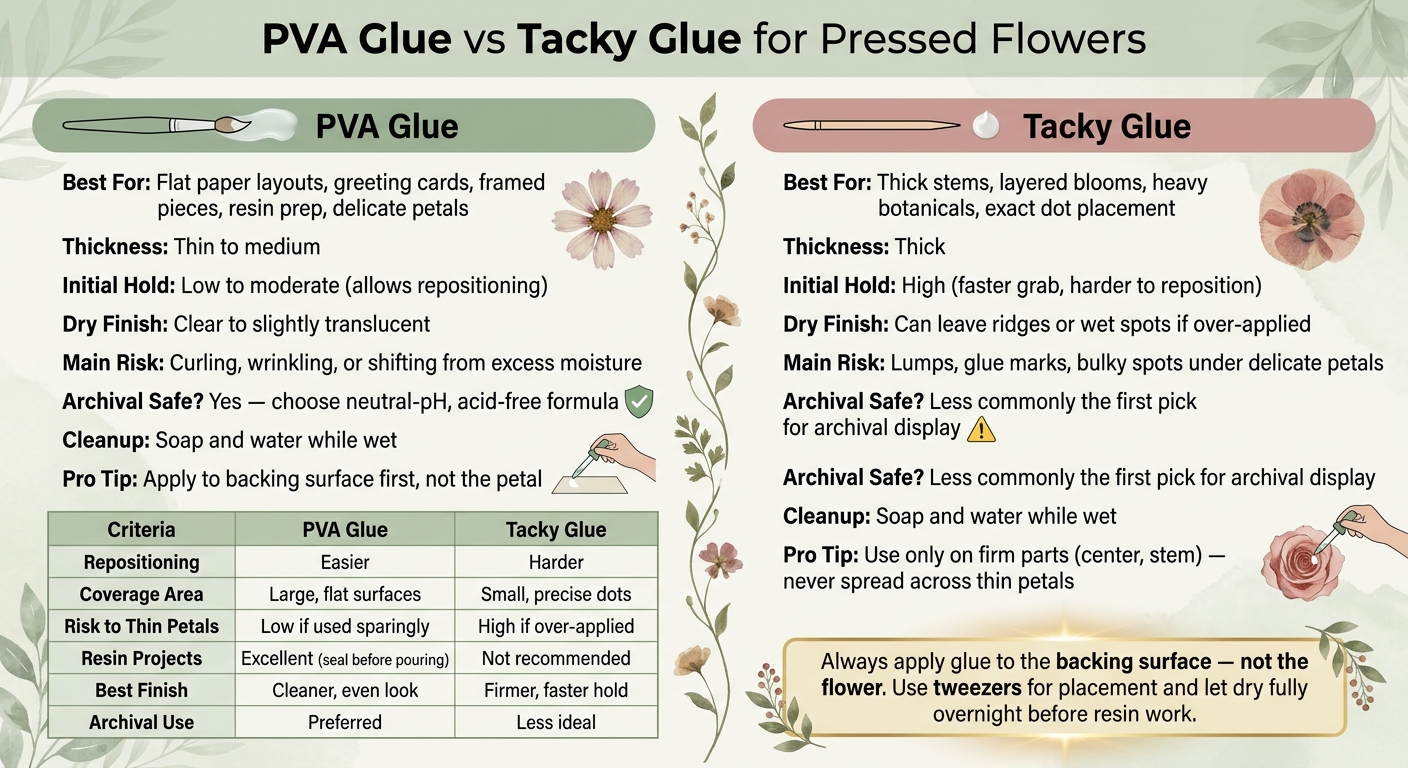
PVA Glue vs Tacky Glue for Pressed Flowers: Quick Visual Guide
I Tested the Most Popular Craft Glues (Here's the Winner!)
sbb-itb-80d8183
Quick Comparison
| Criteria | PVA Glue | Tacky Glue |
|---|---|---|
| Best use | Flat paper layouts, cards, frames, resin sealing | Thick blooms, stems, layered pieces, exact dots |
| Thickness | Thin to medium | Thick |
| Initial hold | Lower | Higher |
| Repositioning | Easier | Harder |
| Finish on thin petals | Usually cleaner if used lightly | Can leave ridges if overused |
| Main risk | Curling, wrinkling, shifting from moisture | Lumps, glue marks, bulky spots |
| Cleanup | Soap and water while wet | Soap and water while wet |
| Better for archival display | Yes, if neutral-pH and acid-free | Less often the first pick for this |
In plain terms: choose PVA when you want even coverage and a cleaner look, and choose tacky glue when you need a flower to stay put fast. The rest of the article breaks down where each one works best and how to use both without tearing petals or leaving marks.
PVA Glue for Pressed Flowers
PVA is a water-based adhesive that brushes on smoothly over paper, cardstock, mat board, handmade paper, and wood. It has enough holding power for paper projects while still being gentle on petals. For display pieces, archival-grade, neutral-pH PVA is the better pick.
| Feature | PVA Glue |
|---|---|
| Viscosity | Thin to medium; brushes easily |
| Initial Grab | Low to moderate; allows repositioning |
| Dry Appearance | Clear to slightly translucent |
| Flexibility | Moderate; stays flexible on paper |
| Ideal Surfaces | Paper, cardstock, mat board, handmade paper, wood |
| Cleanup Method | Soap and water while still wet |
Note: Archival-grade, neutral-pH versions are recommended for fine art and long-term display.
Where PVA Glue Works Best
PVA works well for paper crafts, greeting card fronts, mat board layouts, and frame backings. Because it has a thinner consistency, it spreads easily across larger areas like card fronts, mat board, and frame backings. That makes it a good match for flat layouts that need even coverage.
The main thing to watch is the amount you use. A heavy coat adds more moisture, and that can make petals curl at the edges, drift out of place, or leave wet-looking spots once dry. Thin, see-through petals like cosmos or poppies tend to react the most. Using microwave flower pressing can help preserve the color and structure of these delicate blooms before they are glued. The slower set time gives you more room to place flowers neatly, but it also means delicate petals may move before the glue sets.
PVA Glue Strengths and Limits
One of PVA's biggest upsides is its slower set time. You get a bit more room to nudge a petal into place or lift and reset a stem before the bond firms up. Flower Press Studio calls Lineco Neutral pH Adhesive a solid everyday glue for beginners.
There’s a trade-off, though. That same slower set can make flowers slide while the glue is still wet, especially if you use too much. Cleanup is easy with soap and water before it dries. After PVA cures, removing it is much harder and can disturb the surface. If you want a faster grab with less sliding, tacky glue behaves differently.
Tacky Glue for Pressed Flowers
Tacky glue is thicker and sets faster, so it stays where you put it. That makes it a good pick for precise dots and small contact points. Compared with PVA, it gives you more control, but it doesn’t spread as well across broad areas.
| Feature | Tacky Glue Performance |
|---|---|
| Large-Area Coverage | Low; hard to spread evenly over large, thin surfaces |
| Dot Placement | Excellent; stays in place without spreading or running |
| Initial Grab | High; faster initial hold for heavy or multi-layered specimens |
| Dry Time | Moderate to slow; thicker applications need more time to cure fully |
| Residue Risk | High risk of ridges or wet spots if applied to delicate petals |
Where Tacky Glue Works Best
Tacky glue works best on larger, sturdier blooms, especially on thicker sections. If you're working with smaller flowers, use it on the center or other firm parts instead of the petals.
Tacky Glue Strengths and Limits
Its biggest strength is control. The fast grab helps layered or heavier pieces stay put instead of sliding around. That’s handy when placement needs to be exact, such as when making DIY pressed flower stickers.
The tradeoff is coverage. Tacky glue is better for small, controlled spots than for broad, flat surfaces. If you try to spread it too far, it can get uneven fast.
The biggest issue is overapplying it. Too much glue under thin petals can leave ridges, wet marks, or water spots.
Next, compare how tacky glue and PVA perform by project type.
PVA Glue vs Tacky Glue by Project Type
Once you know how each glue behaves, the next step is picking the right one for the job. Thin PVA is the better fit for flat paper layouts and frame backs. Tacky glue works better for sturdier botanicals that need a firmer hold.
| Project Type | Best Choice | Reason | Main Caution |
|---|---|---|---|
| Paper Crafts & Cards | Thin PVA | Spreads evenly on flat paper surfaces | Excess moisture can buckle cardstock and warp paper |
| Framed Art | PVA (Neutral pH) | Best for flat, sealed displays | Must dry completely flat before sealing in a frame |
| Resin Prep | Thin PVA sealant | Anchors flowers and seals petals before pouring | Flowers and glue must be fully dry before resin to prevent clouding |
| Delicate Layouts | Thin PVA applied with a toothpick | Minimizes visible glue lines on translucent petals like cosmos or poppies | Petals tear easily - use tweezers for placement, not fingers |
| Heavy Botanicals | Tacky Glue | High grab for thick stems, pods, or multi-layered blooms like sunflowers | Too much bulk can make flat framing difficult |
Paper Crafts, Cards, and Frames
For flat paper work, coverage matters more than that first quick hold. Thin PVA is usually the best pick for paper layouts and frames because it spreads in a smooth, even layer across the back of a petal without pooling.
That said, less is more. Too much moisture can buckle cardstock and warp paper. Let the finished piece dry flat before framing, ideally with a light weight on top.
Tacky glue can still help in framed pieces, especially when you're dealing with a heavier bloom like a rose bud or a poppy pod. In that case, put it only on the center, stem, or another firm area. A toothpick gives you better control and helps keep the glue where it belongs.
Resin Prep and Delicate Layouts
With resin, the goal changes a bit. You're not just trying to stick the flower down. You also need everything fully dry and held in place. Before adding resin, anchor the flower and seal the petals to help prevent floating, translucency, and water spots.
A thin layer of PVA sealant works well for this. Apply it lightly, then let it dry all the way. Overnight is the safest bet before moving on to resin. Flowers and glue must be fully dry before resin to prevent clouding or color shifts.
For delicate layouts, thin PVA applied with a toothpick helps keep glue lines from showing on translucent petals like cosmos or poppies. These petals tear fast, so use tweezers for placement instead of your fingers.
Flowers pressed with a microwave flower press kit also tend to keep more vibrant color, which can matter a lot in resin pieces where every shade shows.
Hold Strength, Dry Finish, and Final Verdict
Once you know what you’re making, the last call usually comes down to control, finish, and how much pressure the flower can handle. PVA works best for flat, delicate pieces. Tacky glue is a better fit for thicker blooms and jobs where you need the piece to stay put faster.
When it comes to hold strength, PVA dries into a strong, flexible bond that’s a good match for paper pieces that need smooth, even coverage. Tacky glue dries into a firmer hold, which makes it better for thicker stems and layered blooms. As for finish, neutral pH PVA is the safer pick for archival work because acid-free adhesives help reduce discoloration over time.
| Decision Point | PVA Glue | Tacky Glue |
|---|---|---|
| Best for | Delicate petals, paper crafts, cards, resin prep | or a customizable resin tray kit Thicker stems, layered blooms, exact dot placement |
| Main caution | Can wrinkle thin paper if over-applied | May leave visible lumps under delicate petals |
How to Apply Glue Without Damaging Flowers
The sequence matters more than most people think. Put the adhesive on the backing paper or board first, not on the petal itself. Then use fine-tip tweezers to place the flower so you don’t transfer skin oils or press too hard with your fingers.
A toothpick or fine brush helps you keep the amount small and the placement precise. Press lightly. Too much force can leave marks that show up in the finished piece. If extra glue squeezes out, wipe it away right away, then let the piece dry completely flat.
Key Takeaways by Use Case
For thin, porous paper and delicate petals, a thin layer of PVA spread across the backing gives even coverage with less risk. For larger blooms that need a faster grab, a tiny dab of tacky glue can hold them in place without extra bulk. It’s smart to test the dry finish on scrap paper and a spare pressed flower before using either one on the final piece.
Use PVA for paper, frames, and delicate petals. Use tacky glue for thicker blooms and tiny, exact placements. It’s a simple rule, but it goes a long way toward keeping the finish clean and the petals intact.
FAQs
Can I use both PVA and tacky glue in one pressed flower project?
Yes. You can use both in one pressed flower project and get the best from each one.
PVA glue is thinner and spreads with less effort, which makes it a good fit for delicate petals. Tacky glue is thicker and grips more firmly, so it works better for heavier or sturdier plant pieces.
How long should glued pressed flowers dry before framing or adding resin?
For paper crafts, glued pressed flowers usually dry in 20 to 30 minutes.
If you're planning to frame them with sealant or cover them with resin, give the adhesive overnight to dry. Also, make sure the flowers are fully dry before you move on. Even a little leftover moisture or adhesive residue can lead to rot, color changes, or a cloudy resin finish.
What type of PVA glue is best for archival pressed flower art?
For archival pressed flower art, use an acid-free, archival-quality PVA-style adhesive like Lineco Neutral pH Adhesive. It’s made for long-term paper-craft mounting, has a neutral pH, and offers solid hold.
It’s a good glue to start with. It also works well for piecing delicate petals back together when you apply it in a controlled, even layer.





















