










If I want the easiest whole flower to press, I’d pick a daisy. If I want rose color and shape, I’d press the petals or a cut bloom instead of the full flower.
Here’s the short answer: daisies are flatter, thinner, and dry more evenly, while roses are thicker, hold more moisture, and brown or mold more often if pressed whole. In most cases, a daisy can go into the press with little prep. A rose usually needs to be split into petals or cut into a thinner form first.
What matters most:
- Shape: Daisies are flat; roses are layered and bulky
- Moisture: Rose centers stay wet longer
- Prep: Daisies often press whole; roses usually do not
- Dry time: Standard pressing often takes 4 to 6 weeks
- Microwave press time: Some flowers can dry in about 1 minute, with 20- to 30-second checks between rounds
- Color hold: Daisies dry more evenly; roses keep color better after thinning first
The main rule is simple: press daisies whole when dry and flat, and press roses in thinner parts for better results.
Quick Comparison
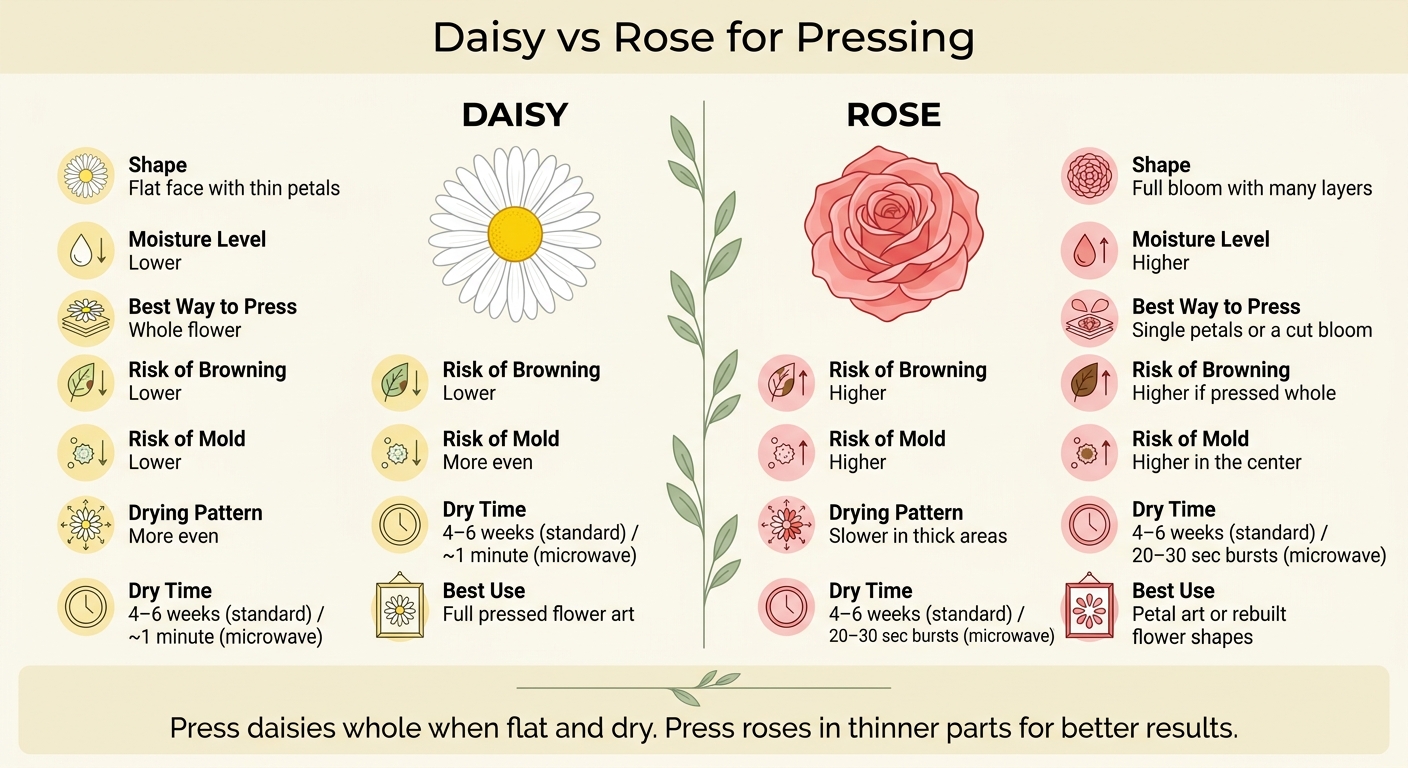
Daisy vs Rose for Pressing: Side-by-Side Comparison
| Feature | Daisy | Rose |
|---|---|---|
| Flower shape | Flat face with thin petals | Full bloom with many layers |
| Moisture level | Lower | Higher |
| Best way to press | Whole flower | Single petals or a cut bloom |
| Risk of browning | Lower | Higher if pressed whole |
| Risk of mold | Lower | Higher in the center |
| Drying pattern | More even | Slower in thick areas |
| Best use | Full pressed flower art | Petal art or rebuilt flower shapes |
If I were choosing between the two, I’d use a daisy for simple whole-flower pressing and a rose for petal-based work.
sbb-itb-80d8183
Daisy Identification and Pressing
What a Daisy Looks Like
A daisy is a composite flower with flat outer ray petals around a dense center. The petals are thin and flat, but the central disk is noticeably thicker. That one detail matters more than most people think. Since the bloom is fairly flat, daisies usually press well as a single flower.
How to Press a Daisy Whole
In most cases, you can press the flower head whole. Trim the stem short first. A long stem adds extra bulk and holds more moisture than you need.
Only press blooms that are fully dry. If the flower has dew or rain on it, browning happens much more often.
Place the flower face down on the absorbent sheet or cotton liner. Then use tweezers to spread the petals into place before you close the press. Once it's shut, that's it - you won't be able to fix the layout later.
Give each bloom a little room. That space helps the paper pull moisture from the entire flower, not just from the outer petals.
Press leaves and stems on their own. They dry at a different pace than the flower head, and putting them together can lead to uneven results.
Drying and Color Results for Daisies
Daisies dry faster than many flowers used for pressing. In a standard press, they usually take 4 to 6 weeks. A microwave press can cut that down to about 1 minute.
White petals can turn translucent or brown at the edges if they get too much heat. The center disk is the tricky part. It holds more moisture than the petals, so it can brown if it doesn't dry at the same pace.
If you're using a microwave press, work in 20- to 30-second bursts. Check the center after each burst. The petals often dry first, while the middle still feels damp.
Roses need more breakup and prep because their layered petals trap moisture.
Rose Identification and Pressing
What a Rose Looks Like
A rose is easy to spot. It has many overlapping petals packed into dense layers, which gives the bloom a rounded, full shape. Unlike a daisy's flat face, a rose stays thick and tight. That layered bloom holds moisture, so it presses slowly compared to faster methods. The plant also has leaves, sepals, and prickles.
That thickness is the main issue. Before pressing, you need to cut down the bulk.
How to Prepare a Rose for Pressing
Don't press a whole rose bloom. The most reliable way is to pull the petals apart first. Start by removing any outer petals that are bruised or damaged. Those marks won't disappear after pressing.
Then you have two good options:
- Press the petals one by one
- Build a thin rose shape by hand with a small cluster of petals, then place that in the press
You can also cut the rose in half lengthwise. This reduces thickness and shows the flower's side profile. Remove the stem and leaves first, then press those as separate pieces.
Drying and Color Results for Roses
Once you thin the bloom, the color tends to hold better. Pressed rose petals can keep strong color, but only if you reduce the thickness first. If too many layers stay in place, the center can stay damp and turn brown, wrinkle, or grow mold.
Daisy vs Rose for Pressing: A Direct Comparison
Here’s how the two flowers compare on the points that matter most when you press them:
| Feature | Daisy | Rose |
|---|---|---|
| Structure/moisture | Flat and thin | Thick and moisture-heavy |
| Whole-flower pressing suitability | High - ideal for pressing intact | Low - prone to mold or browning if pressed whole |
| Preferred preparation | Press whole | Press individual petals or build a thinner bloom |
| Drying/color outcome | Dries quickly and evenly; color stays vibrant | Browns if dried slowly; color holds when thinned first |
| Best use in pressed-flower art | Whole-flower specimens and border accents | Petal-based designs or reconstructed blooms |
The biggest gap shows up in drying speed and color hold.
Pressing Difficulty, Drying Time, and Color Hold
Daisies dry faster because they hold less moisture. Roses carry much more water inside those layered petals, so they need more time to dry. That extra drying time makes browning and mold more likely.
With standard flower pressing methods, flowers can take 4 to 6 weeks to dry all the way. That’s a long stretch for a rose, which is far more likely to brown in the center before it dries evenly. A daisy usually avoids that problem because its shape is flatter and thinner.
Microwave Pressing for Faster Results
If speed matters, microwave pressing can make a big difference. It can cut drying time from weeks to minutes, and that matters most with thicker flowers like roses.
The Microfleur microwave flower press kits are made for fast moisture removal and shorter drying time. For thick flowers like roses, use short bursts of 20–30 seconds and let the press cool between rounds to help prevent scorching. Always follow the manufacturer's instructions, since microwave wattage and flower thickness both affect the result.
Which Flower to Choose for Your Project
Pick the flower based on the finish you want, not just the one you like better. If you’re new to flower pressing or want to keep the bloom whole, start with a daisy. It’s easier to work with, dries fast, and looks good on its own. If you want petal-based designs or plan to rebuild the flower after pressing, a rose can work well once you thin it first.
Press a daisy whole when it is flat and dry. Press a rose in pieces unless it is small and fully open.
Conclusion: The Best Use for Each Flower
After comparing them side by side, the rule is pretty simple: daisies have less moisture and a flat shape, so they press well as a whole flower. Roses are thicker and hold more moisture, so you need to thin them before pressing.
With thick roses, pull off the petals and arrange them into a thinner bloom before you press them. A daisy is the better pick when you want to press a full flower with very little prep. If you are just starting out, check out these flower pressing tips for beginners. Go with rose petals when you want a thinner finish and don’t mind the extra work.
FAQs
Can I press a rose whole?
You can press a whole rose, but it’s often tricky. Roses are thick and bulky, so they don’t flatten as easily as thinner flowers. For better results, press the petals on their own, then layer them later to rebuild the rose shape.
If you want to press a rose whole, use a very fresh flower. Also make sure it’s completely dry, with no dew or rain moisture on it.
When should I use microwave pressing?
Use microwave pressing when you want to dry flowers in minutes instead of weeks. It’s a handy option if you want to keep more of their bright color.
This method works best with fresh, dry flowers, not flowers with rain or dew on them. Flat flowers are the easiest to press, but thicker blooms like roses can work too if you thin them out or press the petals one by one. Use short microwave bursts, and adjust the timing based on your microwave.
How do I stop flowers from browning?
Start with the freshest flowers you can find. They should be dry, with no dew or rain left on them.
If you're using a Microfleur microwave flower press, heat the flowers in short 20- to 30-second bursts. Between each round, let them air out so they don't scorch.
For thicker flowers like roses, take off extra petals that won't be visible once the flower is flat. Press those petals on their own to help cut down moisture.
The faster the flowers dry, the better their color tends to hold, and the less browning you'll see.





















