










If you want flowers that press well, pick flat blooms with low moisture and good color hold. In this guide, I’d put pansies, violas, daisies, cosmos, delphiniums, lavender, baby’s breath, larkspur, Queen Anne’s lace, hydrangea florets, and ferns at the top of the list. Thicker flowers like peonies, dahlias, sunflowers, begonias, impatiens, and full roses take more work and often need to be pressed petal by petal.
Here’s the short version:
- I look at 4 things: shape, moisture level, color hold, and how easy the flower is to press
- Flat, thin flowers are usually the safest choice
- Dense flowers often brown, crease, or stay wet in the center
- For resin, flowers must be fully dry
- A standard press can take 4 to 6 weeks
- Microwave flower pressing can cut drying time to hours
- I’d prep bouquet flowers within 1 to 2 days of the wedding
- For thick flowers in a microwave press, use 20- to 30-second bursts
If you’re deciding flower by flower, here’s the fast takeaway:
- Best easy picks: pansies, violas, daisies, cosmos, delphiniums
- Best filler flowers: baby’s breath, lavender, larkspur, Queen Anne’s lace
- Best greenery: ferns; eucalyptus works, but it can darken
- Use with care: roses, ranunculus, lisianthus, peonies, dahlias, sunflowers
- Best for cards and bookmarks: thin, flat blooms
- Best for frames: a mix of focal flowers, filler, and flat greenery
- Best for resin: fully dried pansies, violas, daisies, and ferns
Quick Comparison
| Flower / Greenery | Presses Well? | Color Hold | Ease | Best Use |
|---|---|---|---|---|
| Pansies / Violas | Yes | Very good | Very easy | Cards, bookmarks, resin |
| Daisies | Yes | Good | Easy | Cards, frames, resin |
| Cosmos | Yes | Good | Easy | Frames, cards |
| Delphiniums | Yes | Very good | Easy | Frames, paper goods |
| Hydrangea florets | Yes | Good | Easy | Frames, gap filler |
| Baby’s breath | Yes | Good | Easy | Filler, frames, cards |
| Lavender | Yes | Very good | Easy | Bookmarks, frames |
| Larkspur | Yes | Good | Easy | Filler, stationery |
| Queen Anne’s lace | Yes | Good | Easy | Filler, frames |
| Ferns | Yes | Very good | Very easy | Borders, all project types |
| Lisianthus | Usually | Good | Medium | Frames |
| Small roses | Sometimes | Good | Medium | Frames, resin |
| Large roses | With petal prep | Fair | Hard | Petal art |
| Ranunculus | With petal prep | Fair | Hard | Petal art, frames |
| Peonies | With petal prep | Poor | Hard | Petal art |
| Dahlias | With petal prep | Poor | Hard | Petal art |
| Sunflowers | With trimming | Fair | Hard | Petal art, test first |
| Eucalyptus | Sometimes | Fair | Medium | Greenery accents |
| Begonias / Impatiens | Risky | Poor | Hard | Test only |
So if I had to sum it up in one line: use thin, flat blooms for the best results, and treat thick flowers as petal projects instead of whole-flower projects.
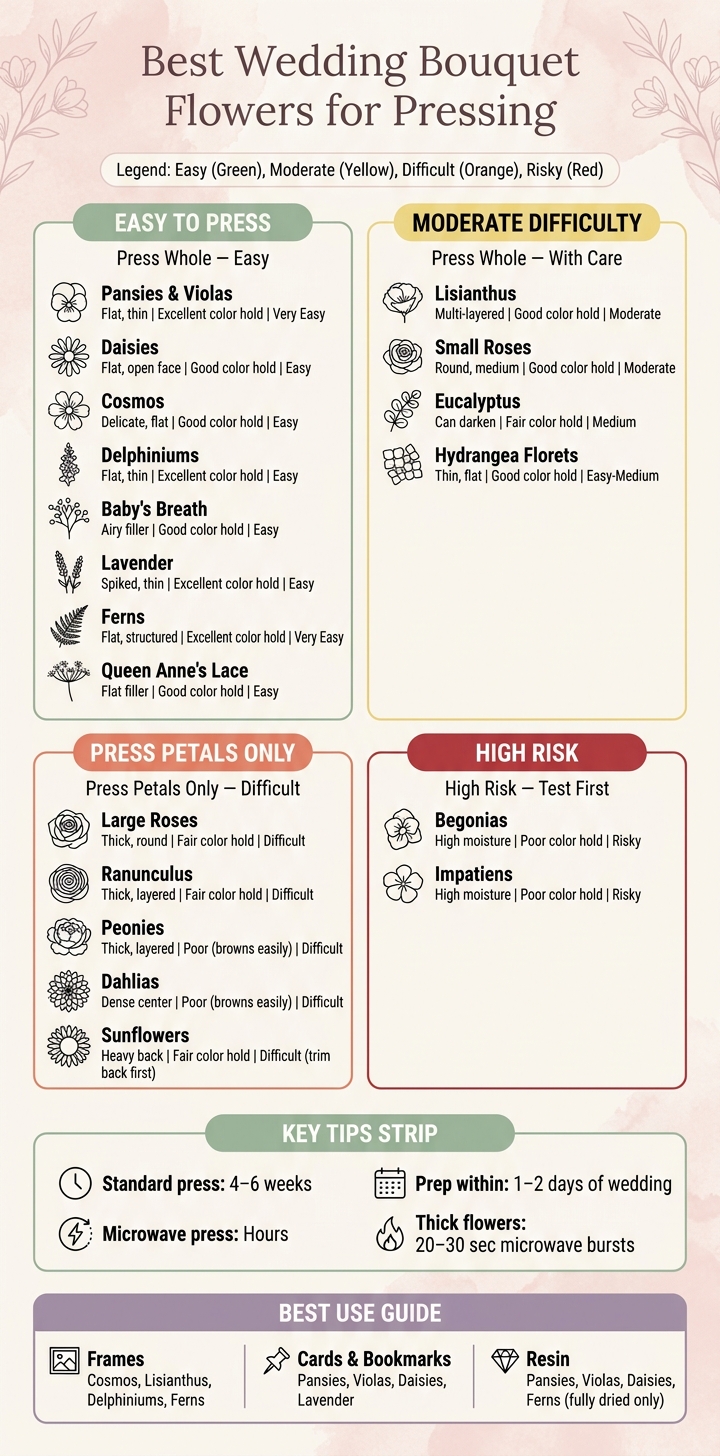
Best Wedding Bouquet Flowers for Pressing: Quick Comparison Guide
Best wedding bouquet flowers for pressing
Pansies, violas, cosmos, daisies, and delphiniums
Pansies, violas, cosmos, and daisies are some of the easiest bouquet flowers to press. Pansies and violas flatten nicely, which makes them a good fit for cards and frames. Cosmos bring a light, airy feel, and their thin petals dry fast. Delphiniums also press well and add line and color to a layout. They tend to work best in framed art and stationery.
For blooms with more layers, properly preparing flowers for pressing by taking the petals apart can make all the difference.
Spray roses, rose petals, ranunculus, hydrangea florets, and lisianthus
Spray roses hold moisture, so it's better to press them petal by petal instead of whole. Ranunculus have thick, layered blooms, which means they often press unevenly. Hydrangea florets are thin and flat, so they're easy to press and handy for filling empty areas in framed pieces. White lisianthus presses well too, but it can blend into white paper. Dark or textured paper helps it stand out.
Once you've handled the larger blooms, lighter fillers can add texture without too much bulk.
Baby's breath, lavender, larkspur, and Queen Anne's lace
These smaller blooms work well when you want fine detail instead of the shape of a full flower. Baby's breath and larkspur press well as light filler flowers. Lavender and Queen Anne's lace are also dependable filler flowers that press flat.
sbb-itb-80d8183
Greenery and flowers to use with care
Ferns, eucalyptus, and other bouquet greenery
Press greenery on its own, not mixed in with blooms. That helps protect both shape and color. Leaves dry at a different pace, and when they sit under petals, they can hold moisture where you don't want it.
Ferns are usually easy to press flat, which makes them a good pick for borders and background layers. Eucalyptus can work too, but there's a catch: if it dries too slowly, it tends to darken. You’ll run into that same slow-drying issue even more with dense flowers.
Stick with small, flat leaves and short stems cut to 2 to 3 inches. Thick stems hold water, dry unevenly, and make mold more likely.
Peonies, dahlias, sunflowers, begonias, and impatiens
These flowers need a lighter touch. Peonies and dahlias have soft, layered centers that hold water deep inside. Sunflowers come with thick, heavy backs. Begonias and impatiens start out with a lot of moisture, so if drying drags out, mold can show up fast. In plain terms, these blooms are harder to press whole.
A better move is to press the petals one by one instead of using the full flower. With sunflowers, trim the back of the flower head first. If you're using a microwave press, go with 20- to 30-second bursts instead of one long cycle. Too much heat in a thick center can lead to browning or even scorch the pressing cloth.
Try one extra bloom first as a test run. Then sort the rest by what they’re best suited for, whether that’s frames, cards, bookmarks, or resin jewelry.
Match bouquet flowers to your finished project
Best picks for frames, cards, bookmarks, and resin
Now that you know which flowers are best for pressing, the next step is simple: pick flowers based on what you want to make.
Framed art usually looks best with a few main blooms, like lisianthus and cosmos, plus flat greenery in the background. Light blooms such as white lisianthus show up better on dark or textured paper, so they don’t fade into the background.
Cards and bookmarks are a better fit for thin, flat flowers like pansies, violas, and daisies.
Resin keepsakes need extra attention. Flowers must be fully dry before they go into resin. If any moisture is left, you can end up with bubbles or a cloudy finish in the mold. Violas, pansies, and ferns are solid choices because they dry cleanly and still look like themselves after pressing.
Comparison table: shape, color hold, pressing ease, and best use
| Flower / Greenery | Shape | Color Hold | Pressing Ease | Best Project Use |
|---|---|---|---|---|
| Pansies and violas | Flat, thin | Excellent | Very Easy | Cards, Bookmarks, Resin |
| Daisies | Flat, open face | Good | Easy | Cards, Frames, Resin |
| Cosmos | Delicate, flat | Good | Easy | Frames, Cards |
| Delphiniums | Flat, thin | Excellent | Easy | Frames (tall accents) |
| Lisianthus | Multi-layered | Good | Moderate | Frames (focal bloom) |
| Small roses | Round, medium | Good | Moderate | Frames, Resin |
| Large roses | Round, thick | Fair | Difficult | Frames (petals only) |
| Lavender | Spiked, thin | Excellent | Easy | Bookmarks, Frames |
| Ferns and greenery | Flat, structured | Excellent | Very Easy | All project types |
| Peonies and ranunculus | Thick, layered | Poor (prone to browning) | Difficult | Frames (petals only) |
Next, prep and press the flowers to help keep their color and shape.
How to prep, press, and check wedding flowers before use
How to prep bouquet flowers for pressing
Once you've picked the blooms that press best, prep them as soon as you can. Timing matters here. Work on the bouquet within 1 to 2 days while the flowers still look fresh and hold their shape well.
Start by taking the bouquet apart and cleaning up each bloom. That means:
- separating the flowers
- removing damaged petals
- trimming damaged ends
- splitting dense blooms into flatter sections or individual florets so they dry more evenly
Before anything goes into the press, each piece should feel dry to the touch. That small check can help prevent mold or browning.
Using a microwave flower press for faster color retention
After prep, you can dry the flowers with short microwave bursts. This saves a lot of time compared with the old-school route.
A standard flower press can take 4 to 6 weeks to dry flowers. A microwave flower press can cut that down to hours. That's a big difference, especially if you want to keep more of the flower's color.
Use short bursts instead of one long cycle, and wipe the press plates between rounds to remove moisture. Think of it like checking on toast - you want it done, not overdone.
The easiest bouquet flowers to save as wedding keepsakes
Once the flowers are pressed, check each one before storage or assembly. Let every flower cool first. Then make sure it feels papery, not sticky or brittle.
Dense blooms, like roses or lilies, often need a bit more prep. Separate them into individual petals or inner petals before pressing so they flatten more evenly.
When the flowers are fully dry, store them in an airtight container with silica gel packets until you're ready for assembly.
How To Press Flowers Like A Professional
FAQs
Can I press my bouquet after it starts to wilt?
For the best results, press your flowers while they’re still fresh. Once blooms start to wilt, they hold extra moisture and begin to break down, which can make drying harder and affect how your finished piece looks.
If you want to keep your bouquet bright and beautiful as a keepsake, press it as soon as possible after your event.
How do I know a pressed flower is dry enough for resin?
A pressed flower is ready for resin when it is completely dry. It should feel crisp, not soft or cool, and there shouldn’t be any moisture left in it. If there’s even a little dampness, the flower can turn transparent or start to spoil once it’s sealed in resin.
A Microfleur microwave flower press can dry flowers fast and help keep more of their color. Before you use any flower in resin, check it with your fingers and make sure it feels fully dry to the touch.
Should I press whole flowers or separate the petals first?
It depends on the bloom and the look you want.
You can press many flowers whole. But thick or layered blooms often need a little prep first. That might mean thinning the petals or pulling the flower apart so it can lie flat and dry evenly.
Shape matters too. Bell flowers, for example, usually look best pressed in profile so their outline stays clear. If you’re not sure, set up the flower based on how you want it to look in the final piece.





















