










I’d choose glassine for easy viewing and parchment for a nonstick surface - but neither dries flowers or stops fading. Before storing, let flowers dry fully; pressing often takes 2–4 weeks. Then use sheets with verified acid-free storage specifications.
My storage checklist is simple:
- Keep flowers flat in a cool, dry, dark box, book, or folder.
- Leave 1/2–1 inch between blooms and avoid heavy pressure.
- Check paper size, labeling options, and cost per usable piece - not just package price.
- Inspect for dampness, sticking, browning, or mold.
Quick Comparison
| Factor | Glassine | Parchment |
|---|---|---|
| Petal protection | Smooth surface reduces rubbing; petals may still stick | Silicone coating helps petals release |
| Moisture | Not a drying paper | Not a drying paper |
| Viewing | Translucent | Varies; opaque sheets need lifting |
| Long-term storage | Verify acid-free and archival specifications | Kitchen parchment is not automatically archival |
| Labeling | Usually easier to write on | Coating can make writing difficult |
| Fit and cost | Check sheet, roll, or envelope dimensions | Often cheaper in bulk; allow for cutting waste |
My bottom line: <u>dryness comes first</u>. Choose parchment, not wax paper, and use either material as a protective layer - not a preservative.
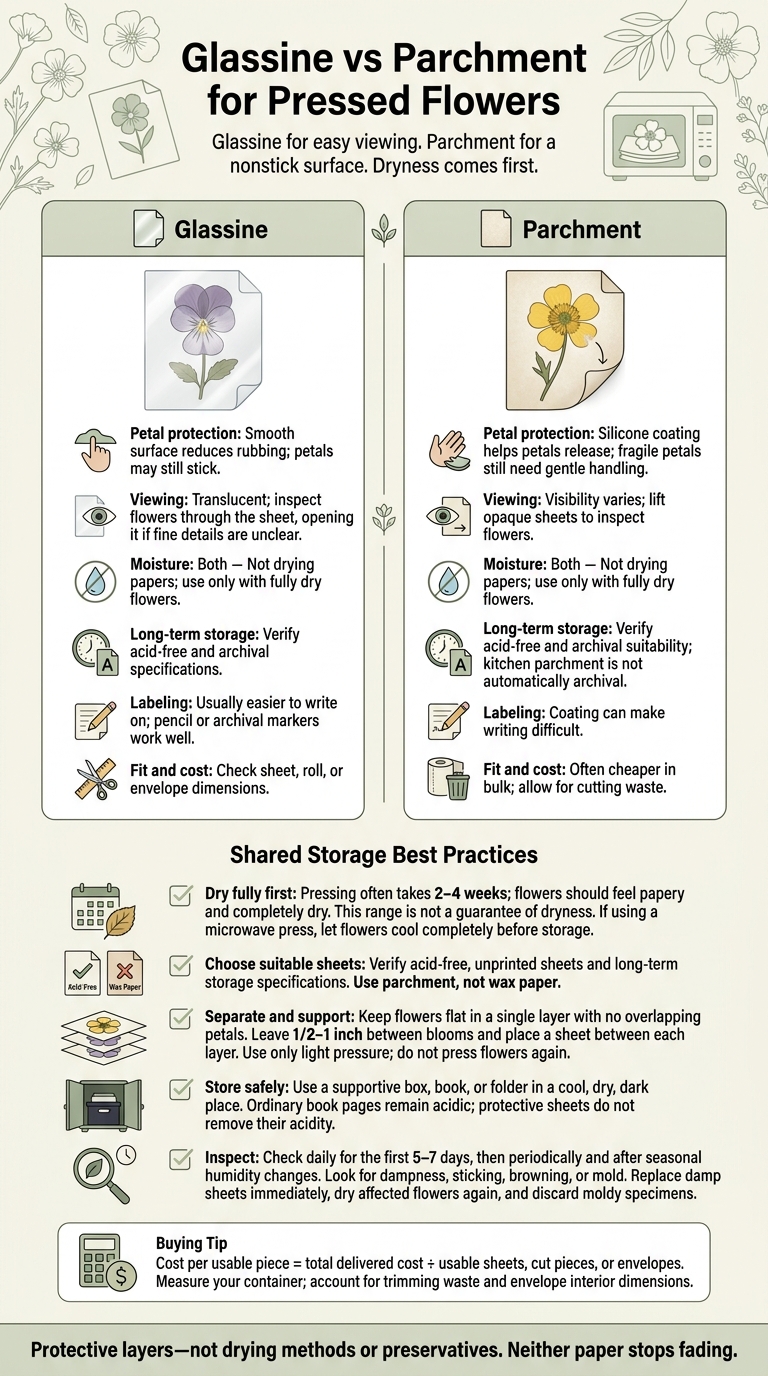
Glassine vs Parchment for Pressed Flowers
What Glassine and Parchment Can and Cannot Do
Use parchment paper, not wax paper. Kitchen parchment is usually silicone-coated. Wax paper is a different material and isn’t recommended for long-term storage of pressed flowers.
The main differences are visibility, surface release, and archival quality for flower pressing beginners. Neither paper preserves color on its own. Instead, paper helps protect color by reducing friction, sticking, and contact with acidic materials.
Glassine: Smooth, Translucent Storage Layers
Glassine lets you check your flowers through the sheet without opening the layer. Choose acid-free sheets for storage.
| Criterion | Advantage | Limitation |
|---|---|---|
| Sticking | Smooth, glazed surface reduces friction | Petals can still stick, especially if moisture remains |
| Moisture | Keeps finished specimens separated | Absorbs little moisture; unsuitable for drying damp flowers |
| Visibility | Flowers remain visible through the sheet | You may need to open the layer to see fine details |
| Handling | Helps protect petals from rubbing | Delicate flowers still need gentle handling |
| Storage uses | Works between folders, portfolios, and similar flat storage layers | Long-term suitability depends on the paper’s specifications |
Parchment: Nonstick Storage Layers
Parchment paper’s silicone coating gives it a strong nonstick surface. Choose acid-free sheets for storage, and check their archival suitability: kitchen parchment isn’t automatically archival.
| Criterion | Advantage | Limitation |
|---|---|---|
| Sticking | Coating reduces adhesion | Fragile petals need careful handling, even when they release |
| Moisture | Keeps flowers separated from other layers | Does not wick away moisture during drying |
| Visibility | Some sheets are translucent | More opaque sheets must be opened for inspection |
| Handling | Sturdy enough to place between layers | Flowers can slide, so keep layers flat |
| Storage uses | Separates flowers from book pages and other flat layers | Archival suitability must be verified |
Your paper choice matters only once the flowers are fully dry.
Dry Flowers Fully Before Storage
Store flowers only when they’re fully dry. Trapped moisture can cause browning, decay, or mold. Nonstick storage layers aren’t a substitute for absorbent drying papers.
If you use a microwave press, let the flowers cool completely before storing them. They should feel papery and completely dry before going into storage.
sbb-itb-80d8183
Glassine vs Parchment for Storing Pressed Flowers
Once flowers are fully dry, choose storage paper based on how it protects petals, lets you inspect them, and fits your container. The goal is to prevent sticking, abrasion, and fit problems, which is also a key part of storing pressed flowers correctly.
| Storage factor | Glassine | Parchment |
|---|---|---|
| Sticking | Smooth surface reduces snagging | Nonstick coating helps petals release |
| Moisture handling | Nonabsorbent; does not dry flowers | Nonabsorbent; does not dry flowers |
| Color retention | Choose archival or acid-free glassine for storage | Check for acid-free or archival labeling; kitchen parchment is not automatically archival |
| Visibility | Translucent; lets you inspect flowers without removing the covering sheet | Some sheets are translucent; lift opaque sheets to inspect flowers |
| Friction protection | Smooth surface helps reduce petal abrasion | Separates layers and helps protect flowers from contact |
| Cost | Often sold in specialized archival packs or rolls | Readily available and often cheaper in bulk |
Next, consider how easily you can check and move delicate flowers without damaging them.
Inspecting Flowers and Preventing Sticking
Store flowers flat in a single layer, with no overlapping petals. When reopening a box, book, or folder, gently move fragile flowers with craft tweezers. If a petal sticks, lightly bend the paper away from the flower instead of pulling the flower upward.
| Task | Glassine | Parchment |
|---|---|---|
| Inspection | Check the outline through the sheet before opening | Lift the covering sheet if it hides details |
| Petal release | Ease the paper away from any stuck petal | Nonstick coating helps petals release; avoid tugging |
| Labeling | Pencil or archival markers work well | Coatings can make writing difficult |
| Short-term use | Useful for temporary layering or sorting | Useful for temporary nonstick layers |
| Long-term use | Choose sheets with verified archival specifications | Verify storage suitability; kitchen parchment is not automatically archival |
Storing flowers for months or years? Check the supplier’s material specifications before buying. The paper name alone doesn’t tell you whether it suits long-term storage.
Price matters, too - but the cheapest package isn’t the best value if most of it goes unused.
Comparing Cost per Usable Sheet
Compare delivered cost per usable sheet or cut piece, not just the package price.
| Purchase format | Usable dimensions to check | Cutting waste | Specifications to check | Cost calculation |
|---|---|---|---|---|
| Precut sheets or packs | Listed sheet size and fit inside your container | Trimming may be needed | Acid-free status and stated storage suitability | Total delivered cost ÷ usable sheets |
| Glassine rolls | Roll width and cut length, in inches | Offcuts from your chosen layout | Acid-free and unbuffered specifications | Total delivered cost ÷ usable cut pieces |
| Parchment rolls | Actual roll width and cut length | Trimming and curled edges can create waste | Storage suitability and pH neutrality | Total delivered cost ÷ usable cut pieces |
| Glassine envelopes | Interior dimensions, excluding flap and seams | Little cutting waste, but flowers must fit | Paper specifications and intended storage use | Total delivered cost ÷ usable envelopes |
Measure your box or folder before ordering. A larger sheet offers better value only if the extra area gives you usable pieces. Scraps too small to protect your flowers don’t lower the actual cost.
How to Store Flowers in Boxes, Books, and Folders
Pack flowers only when they’re fully dry, and keep each layer flat. Glassine and parchment are storage barriers - not drying methods or preservatives. Flowers need to stay dry, separated, and protected from pressure.
Leave 1/2 to 1 inch between blooms, with a sheet between each layer. Use only light pressure. Don’t press the flowers again.
The container setup matters more than the paper: keep flowers supported, apart, and out of light.
| Storage format | Using glassine or parchment | Main precaution |
|---|---|---|
| Flat boxes | Place a sheet between each layer | Leave space between flowers and avoid putting weight on the box |
| Books and albums | Place sheets between flowers and pages, covering both sides of each flower | Ordinary book pages remain acidic |
| Folders and portfolios | Place flowers between individual sheets inside a supportive folder | Store flat to prevent flowers from sliding or bunching |
For boxes, a shallow stack with plenty of room works best.
Flat Boxes: Keep Flower Layers Separate
Choose a rigid, flat box and prepare flowers for pressing correctly to ensure they stay flat. Keep the stack low enough that the lid closes without pressing on the blooms. Store the closed box somewhere cool, dry, and dark. Inspect both the top and lower layers for moisture.
Books and Albums: Avoid Acidic Page Contact
Protective sheets limit contact with pages, but they don’t remove the acidity of ordinary book paper. Choose acid-free pages to help retain color, rather than relying on barriers alone. Don’t overfill albums or use tight closures that crush petals.
Folders and Portfolios: Support Flowers and Store Flat
Use supportive folders and give flowers individual protective sheets. Label each folder outside the sheets with the flower name, date, and location. Store folders flat, away from windows, bathrooms, damp basements, and swings in temperature or humidity.
Check daily for the first 5–7 days, then periodically and after seasonal humidity changes. Look for sticking, damp sheets, browning, or mold. Replace damp sheets immediately, dry affected flowers again, and discard moldy specimens. If dry flowers turn brown, check their exposure to light and acidic materials.
Conclusion: Choose Paper for Your Storage Needs
Choose paper based on its storage role. Paper alone won’t preserve flower color.
| Material | Choose it for | Limits |
|---|---|---|
| Glassine | Easy inspection | Not absorbent; provides no rigid support |
| Parchment | A nonstick layer between flowers and surfaces | Low absorbency; use only with fully dry flowers |
Before storing flowers, check that the sheets are acid-free and unprinted.
Dryness matters most. Store only fully dry flowers in a cool, dry, dark place. Paper separates and protects them, but neither glassine nor parchment replaces absorbent drying layers found in professional flower pressing kits or prevents fading over time.
FAQs
Can I reuse glassine or parchment for flower storage?
Yes, you can reuse parchment paper to store pressed flowers. Place dried flowers between sheets to keep them organized in containers or boxes.
Before reusing a sheet, check that it’s clean, dry, and free of large stains. If a previous flower left a stain, you can set that sheet aside for blooms of a similar color to help avoid color transfer.
How can I verify that storage paper is archival?
Choose acid-free storage paper, and look for products labeled archival or acid-free. Acids in paper can make pressed flowers discolor, turn brown, or become brittle over time.
Non-archival paper - including some book pages - may transfer acids to your flowers as it ages, reducing their quality and ability to retain color.
Should I use different papers for different flowers?
Yes. Press flowers of similar thickness together. Thicker blooms take longer to dry and need periodic checks and paper changes to keep moisture from building up and causing mold.
Parchment protects book pages and keeps flowers from sticking, but it isn’t always the most absorbent option. For flowers with lots of moisture, use absorbent blotting paper.
For the fastest results and better color retention, especially with thicker blooms, consider a Microfleur microwave flower press.





















