










Some flowers should not go in a microwave press at all. If a bloom is thick, fleshy, or wet, it is much more likely to come out with brown edges, sticky petals, or a damp center.
I’d keep it simple: avoid pressing whole roses, peonies, dahlias, mums, begonias, orchids, purslane, sunflowers, and lilies unless you trim them down first. In most failed presses, the problem comes from 3 things: too much heat, too much moisture, or too much bulk.
Here’s the short answer:
- Do not microwave-press wet flowers
- Do not press dense blooms whole
- Do not expect fleshy petals to dry evenly
- Use short bursts of about 20–30 seconds
- Stop only when the flower feels dry and papery
A fast way I think about it:
| Flower type | Common examples | What usually goes wrong |
|---|---|---|
| Dense blooms | Roses, peonies, dahlias, mums | Outer petals dry first, center stays wet |
| Fleshy blooms | Begonias, orchids, purslane | Steam, scorch marks, sticky spots |
| Bulky flowers | Sunflowers, lilies, large mums | Press won’t close flat, middle stays damp |
| Wet flowers | Any bloom with rain or dew on it | Brown patches, faded color, uneven drying |
One useful rule: if a flower has a thick center, heavy base, or soft water-filled petals, I would not press it whole in the microwave.
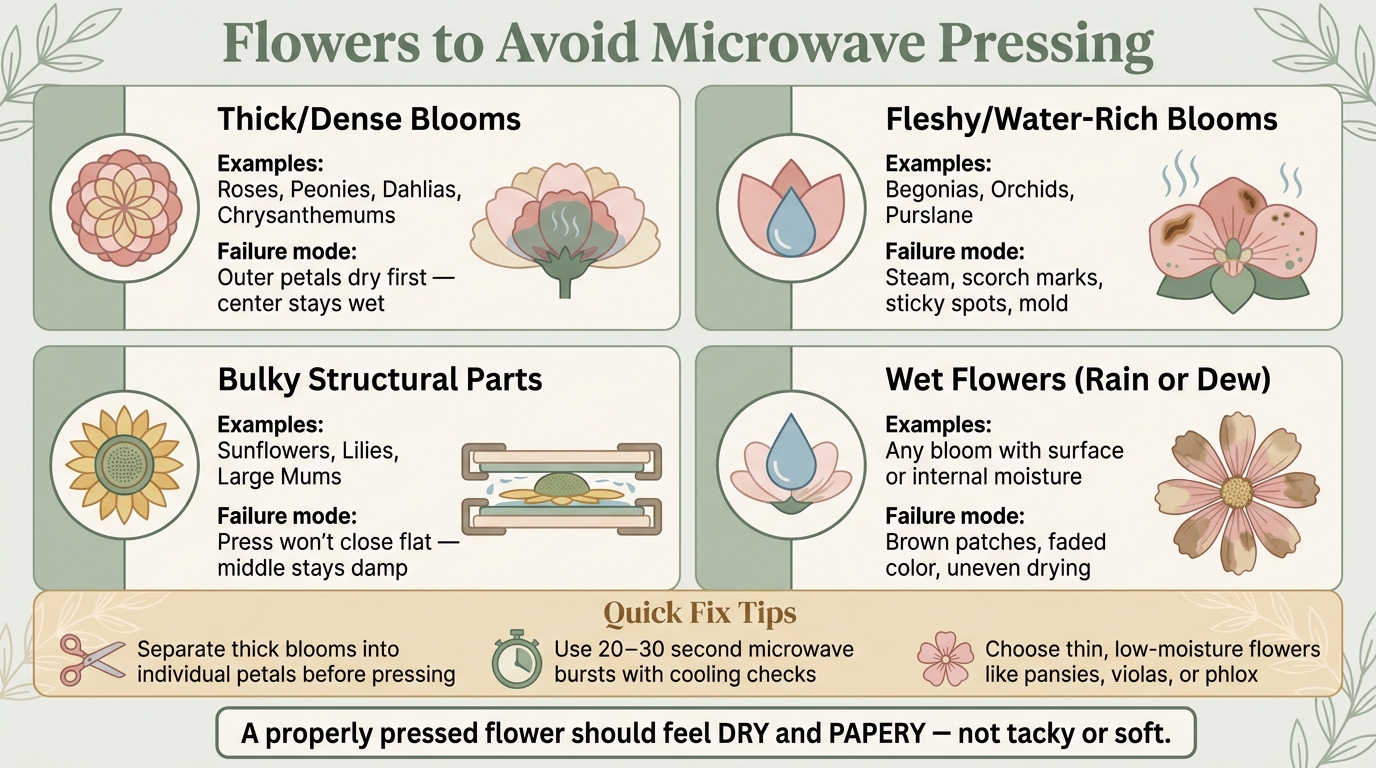
Flowers to Avoid Microwave Pressing (By Type & Failure Mode)
Flowers Most Likely to Scorch, Collapse, or Turn Patchy
Not all flowers go wrong in the same way. The shape of the bloom usually tells you what will happen before it ever goes into the press.
Thick, Dense Blooms: Roses, Peonies, Dahlias, Mums
Whole roses, peonies, dahlias, and mums often dry unevenly because their packed, layered centers hold moisture. That trapped moisture slows drying in the middle while the outer petals dry first.
Don't press these blooms whole in a microwave flower press. Press thick flowers in layers or as separate petals instead.
Fleshy, Water-Rich Flowers: Begonias, Orchids, Succulent Blooms
Begonias, orchids, and succulent-type blooms such as purslane carry so much water that they tend to steam instead of dry. When that happens, you usually get stickiness, scorching, or mold.
Bulky Parts That Prevent Flat Drying
Thick centers, prominent stamens, bulky calyxes, and woody stems can stop the press from closing flat. And that's where things start to fall apart.
If the press can't make even contact, the raised part stays wet while the thinner petals around it dry too much. Sunflowers often fail for this exact reason: the thick center lifts the press and traps moisture. The same problem shows up in flowers with heavy calyxes. The petals may press well, but the base stays damp and can rot.
Here's a quick way to connect flower structure with the most common problem:
| Flower Category | Examples | Primary Failure Mode |
|---|---|---|
| Thick/Dense | Roses, Peonies, Dahlias, Chrysanthemums | Browning, limp centers |
| Fleshy/Water-Rich | Begonias, Orchids, Purslane | Stickiness, scorching, mold |
| Bulky Structural Parts | Sunflowers, Lilies, Mums | Wet centers, overcooked outer petals |
Next, even flowers that usually press well can still fail if they start out wet.
sbb-itb-80d8183
When Wet Flowers Should Not Go Into the Microwave Press
Wet flowers and microwave flower pressing doesn't always mix well with moisture. When a flower goes in with too much moisture, it can steam instead of dry. That often leads to browning, patchy spots, and petals that dry unevenly.
And it's not just about water sitting on the outside. A flower's internal moisture changes the way it dries, which is why two flowers that look equally dry can behave very differently in the microwave.
Rain, Dew, and Surface Moisture
Pick flowers only when they are fully dry. If petals are damp from rain or dew, blot them gently and let them air-dry before pressing. That small step can make a big difference.
The key point here is simple: a flower can feel dry on the surface and still hold a lot of water inside. So surface dryness alone doesn't always mean it's ready for a microwave press.
Surface Dampness vs. Naturally Fleshy Petals
Surface dampness is not the same as internal moisture. Blotting a thin flower dry can be enough to make it press normally. Succulent-like petals hold internal water, so blotting the surface does not prevent scorching or uneven drying.
These flowers are much more likely to scorch or dry unevenly in a microwave press, regardless of how dry they appear on the outside.
What to Do Instead: How to Press Difficult Flowers More Safely
When a bloom is too thick or too wet to press whole, switch methods.
Separate Large Blooms Into Petals or Flatter Sections
Some flowers are just too bulky to behave in a press. In those cases, it helps to break them down first.
For thick blooms like roses, remove the petals and press them flat as separate pieces. Cut tulips in half vertically so you get two flatter sections. For trumpet-shaped blooms, trim them so they can lie flatter before pressing.
Use Short Heating Bursts With Cooling Checks
If the flower still holds moisture, dry it in short bursts so it doesn’t scorch.
Use short bursts instead of one long cycle. Microfleur notes that drying works best in multiple short bursts. Intervals of about 20–30 seconds give steam time to escape between rounds.
After each burst, open the press and wipe off any condensation from the press plates. If the press feels too hot to handle, let it cool before you touch it. The wool pads and flowers hold heat and steam. Stop when the flower feels papery and dry, not sticky. Too much time causes burning.
Choose Flowers That Press More Reliably
If you want an easier start, go with thin, low-moisture flowers like pansies, violas, or phlox.
If a flower still turns brown or stays sticky, match that symptom to the cause below.
Troubleshooting: Match the Symptom to the Cause
Brown Edges, Limp Centers, Sticky Petals, and Patchy Color
When a bloom doesn’t turn out well, the result usually points to one of three issues: heat, moisture, or structure. So instead of only changing the timer, look at the symptom first.
| Symptom | Likely Cause | Recommended Response |
|---|---|---|
| Brown or black edges | Burst too long or wattage too high | Shorten bursts and add cooling time |
| Limp center, dry outer petals | Flower is too thick | Press the petals separately |
| Sticky or damp petals | Moisture remains in the tissue | Keep using short bursts until it feels dry and papery |
| Patchy or faded color | Flower went in wet | Press only fully dry blooms |
| Collapsed or mushy petals | Petals are naturally fleshy | Avoid the microwave press; make sure the surface is fully dry before microwaving |
A properly pressed flower should feel dry and papery, not tacky or soft. If it doesn’t, give it more time in short bursts.
Treat the symptom like a clue. It tells you what to change about the flower itself, not just how long to heat it.
Key Takeaways for Better Microwave Flower Pressing
Never press a bloom that’s still wet. Surface moisture from rain or dew can lead to patchy color and damp petals.
Also, don’t press thick or fleshy flowers whole. Roses, sunflowers, dahlias, and succulent-type blooms often need to be taken apart or pressed with a more standard method.
The short version is simple, and you can find more inspiration in our pressed flower project book:
- Avoid wet, thick, or fleshy flowers.
- Break bulky blooms apart.
- Use short heating bursts and check the flower as it cools.
FAQs
Can I press roses or peonies if I remove the petals first?
Yes - for thick flowers like roses and peonies, removing the petals first is usually the best way to press them well.
A whole bloom is often too dense to flatten on its own. The center holds a lot of moisture, which makes drying harder and can lead to browning or uneven pressing. Individual petals, on the other hand, dry flatter and with less trouble.
If you want the look of a complete flower, you can press the petals one by one and then reassemble a smaller set later. That gives you a natural, full-flower look without the bulk of the original bloom.
How do I know when a flower is too wet for microwave pressing?
A flower is too wet for microwave pressing if it still feels damp or you can see moisture from rain or dew. For the best results, pick flowers only when they’re completely dry.
When you can, go with fresh, papery, thin blooms. They press better and dry more evenly. If a flower is thicker or holds more moisture, thin out the petals and press them on their own. That helps lower the chance of scorching, collapsing, or ending up with patchy color.
Which flowers are safest for beginners to microwave press?
For beginners, the safest flowers to microwave press are thin, papery blooms that already sit fairly flat. Good options include phlox, calico, evergreens, ferns, and leaves.
It also helps to start with lighter-colored, imperfect blooms while you test your microwave timing. That way, if a flower scorches or curls a bit, you’re not learning the hard way on your favorite stems.





















