










I’d choose microwave pressing for cards needed today and book pressing if I had 2–4 weeks. Both can make flat flowers for cards; the main trade-offs are time, color, cost, and heat.
Quick Comparison
| Factor | Microwave press | Book press |
|---|---|---|
| Drying time | About 90 seconds to a few minutes | About 2–4 weeks |
| Color | Often stays brighter; heat can scorch petals | May fade or brown during drying |
| Flatness | Works well with thin flowers; thick centers need preparation | Steady pressure flattens thin flowers |
| Cost | Requires a press and microwave | Can cost $0 with books and suitable paper |
| Keepsakes | I’d test short heating cycles on spare flowers first | Avoids heat, but damp flowers can mold |
For either method, I’d start with pansies, violas, or individual petals and practice before pressing sentimental flowers. My rule for assembly: <u>glue only fully dry flowers</u>, use a thin layer of clear-drying PVA, and store finished cards flat, away from light and moisture.
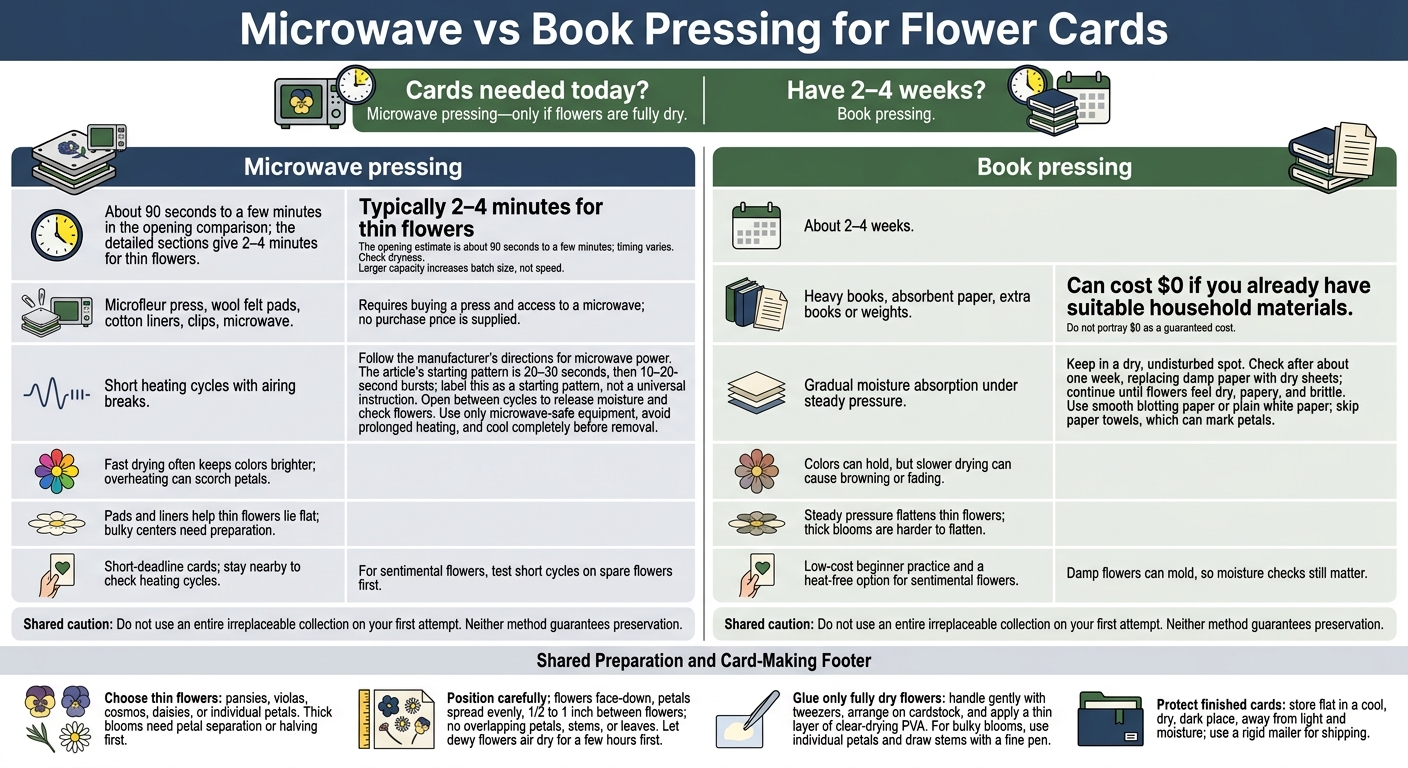
Microwave vs Book Pressing for Flower Cards
Microwave vs Press vs Book | Which Dries Flowers Best?
sbb-itb-80d8183
How Each Pressing Method Works
For either method, place flowers face-down with petals spread evenly, leaving 1/2 to 1 inch between flowers. Keep petals, stems, and leaves from overlapping. Let dewy flowers air dry for a few hours first, and use craft tweezers to position them carefully. The main difference is drying time: microwave pressing uses short bursts of heat, while book pressing uses steady pressure.
| Method | Equipment | Drying process | Typical drying time |
|---|---|---|---|
| Microwave pressing | Microfleur press, wool felt pads, cotton liners, clips, microwave | Short heating cycles with airing breaks | 2–4 minutes; larger capacity increases batch size, not speed. |
| Book pressing | Heavy books, absorbent paper, extra books or weights | Gradual moisture absorption under steady pressure | 2–4 weeks |
Microwave Pressing With Short Heating Cycles
Microfleur presses have vented plates, wool felt pads, cotton liners, and clips. Place the flowers on a liner, cover them with the matching layers, and clip the press shut.
Pansies, violas, forget-me-nots, larkspur, and daisies work well.
Follow the manufacturer’s directions for your microwave’s power. A good starting pattern is 20–30 seconds, then 10–20-second bursts. Open the press between cycles to release moisture and check the flowers. Use only microwave-safe equipment, avoid prolonged heating, and let the flowers cool completely before taking them out.
For a simpler setup, book pressing needs only paper, weight, and time.
Book Pressing With Paper and Weight
Place flowers between sheets of smooth blotting paper or plain white paper inside a heavy book. Group flowers of similar thickness together, gently close the book, and distribute extra books or weights evenly on top. Skip paper towels - their texture can leave marks on petals.
Violets, pansies, and individual rose petals are good practice materials.
Keep the setup in a dry spot where it won’t be disturbed. Check after about one week, replacing any damp paper with dry sheets to reduce browning and mold. Keep pressing until the flowers feel dry, papery, and brittle.
Drying Time, Color, and Flatness Compared
For greeting cards, choosing between microwave and book pressing comes down to speed, color, flatness, and cost.
| Factor | Microwave pressing | Book pressing |
|---|---|---|
| Drying time | Thin flowers often dry in 2–4 minutes and can be ready the same day if fully dry after one session. | Flowers take roughly 2–4 weeks to dry fully. |
| Color retention | Fast drying often keeps colors brighter, but overheating can scorch petals. | Colors can hold, but slower drying increases the risk of browning or fading. |
| Flatness | Pads and liners help flowers lie flat on cards. Bulky centers need extra care. | Steady pressure produces flat results, though thick blooms are harder to flatten. |
| Cost | You'll need to buy a press as well as have access to a microwave. | Can cost $0 if you already have suitable household materials. |
Speed is the biggest difference: microwave heat dries flowers quickly, while book pressing uses gradual absorption over several weeks. With either method, thin flowers make the cleanest card fronts.
Flowers That Press Flat
Choose suitable flowers for pressing such as thin, single-layer violas, pansies, cosmos, and daisies. Thick blooms need petal separation or halving first.
Your deadline and budget usually decide which method fits.
Choosing by Deadline and Budget
| Card-making situation | Better fit | Practical trade-off |
|---|---|---|
| Short-deadline cards | Microwave pressing | Flowers dry fast, but you need to stay nearby to check each heating cycle. |
| Low-cost beginner practice | Book pressing | Equipment costs little or nothing, but results take longer. |
| Sentimental flowers | Book pressing | Best for irreplaceable flowers because it avoids heat. |
Microwave pressing lets beginners see results sooner. Book pressing costs the least to get started if you don't mind waiting. For irreplaceable flowers, don't use the entire collection on your first attempt.
Making Flower Keepsake Cards
Flower keepsake cards start with fully dry blooms. Handle them gently during assembly, then store them carefully to help preserve their color.
Recording Details and Checking Dryness
Note the flower’s source, occasion, and date in a notebook or digital journal so you can include those details on your card.
Let microwave-pressed flowers cool before checking them. They should feel thin, papery, and dry to the touch. For book-pressed flowers, make sure both the blooms and paper are fully dry before handling the flowers with tweezers. Then you’re ready to plan the layout and mount them.
Attaching Flowers Without Bulk
Arrange the flowers on cardstock before gluing them down. Use a small amount of clear-drying PVA glue, spreading a thin layer on the back of each flower or petal. If a bloom is bulky, use individual petals and draw stems with a fine pen to keep the card flat.
Once the flowers are mounted, keep the design away from light and moisture. If you’re shipping the card, use a rigid mailer.
Protecting Cards From Light and Moisture
Store finished cards in a cool, dry, dark place to slow browning and fading.
Conclusion: Which Method Fits Your Cards?
Let your deadline guide your choice. Use microwave pressing for fast results and bright colors. Watch closely to avoid scorching.
Use book pressing for the lowest cost, a flatter finish, and a heat-free way to preserve keepsakes.
For card fronts, pick thin, naturally flat flowers such as pansies, violas, cosmos, and daisies. Attach them to cardstock only when fully dry. For creative inspiration, explore pressed flower projects for your cards. Store the finished card flat, dry, and away from light.
FAQs
Can I microwave flowers after book pressing?
No, you should not microwave flowers after book pressing. The Microfleur microwave flower press dries flowers in short, controlled bursts of heat. Book pressing, on the other hand, lets flowers dry naturally over several weeks.
Flowers that are already dry don’t need microwave heat - it could scorch or burn the delicate plant material. Choose either microwave pressing or book pressing from the start for the best results.
Why do my pressed flowers curl?
Flowers can curl if they’re positioned incorrectly or pressed with too little or uneven pressure. Arrange the blooms carefully before adding the liners - they’re hard to adjust afterward.
In a microwave press, flowers can also curl if they haven’t dried completely or moisture is removed unevenly. For the best results in greeting card projects, start with newly picked flowers that are dry on the surface, and lay them flat without overlapping.
How long will flowers last on a card?
Fully dried flowers can last for years when properly secured to a greeting card. To protect the flowers and their color, store finished cards in a cool, dry, dark place.
The Microfleur microwave press dries flowers quickly and helps preserve their vibrant colors, keeping your keepsakes beautiful over time. You can handle dried flowers, but treat them gently - they’re still delicate.





















