










I’d start with a single layer for control and use stacked layers only when your press allows them. Leave 1/2 to 1 inch or more between flowers, and never overlap them within a layer.
The trade-off? Single layers make drying, color, and shape easier to check. Stacked layers hold more flowers, but uneven drying can leave some blooms damp while others overheat.
For either setup, I’d match flower thickness and moisture, use the required liners and pads, and follow the model’s heating and cooling instructions. More layers don’t mean you should multiply the heating time. <u>Check every permitted layer and stop heating finished flowers.</u>
Quick Comparison
| What matters | Single layer | Stacked layers |
|---|---|---|
| Capacity | Fewer flowers per batch | More flowers per batch |
| Loading | Space flowers apart | Space flowers on each level; load evenly |
| Drying checks | Easier to inspect | Every layer needs checking |
| Color and shape | Easier to monitor and adjust | Uneven loading or heating can cause damage |
| Heating time | Follow model instructions | Don’t multiply time by layer count |
| My starting choice | First batches and delicate blooms | Larger batches, only when allowed |
A 5 × 5-inch press suits smaller projects; a 9 × 9-inch microwave flower pressing kit gives larger blooms more room. Neither size removes the need for careful loading, cooling, and dryness checks.
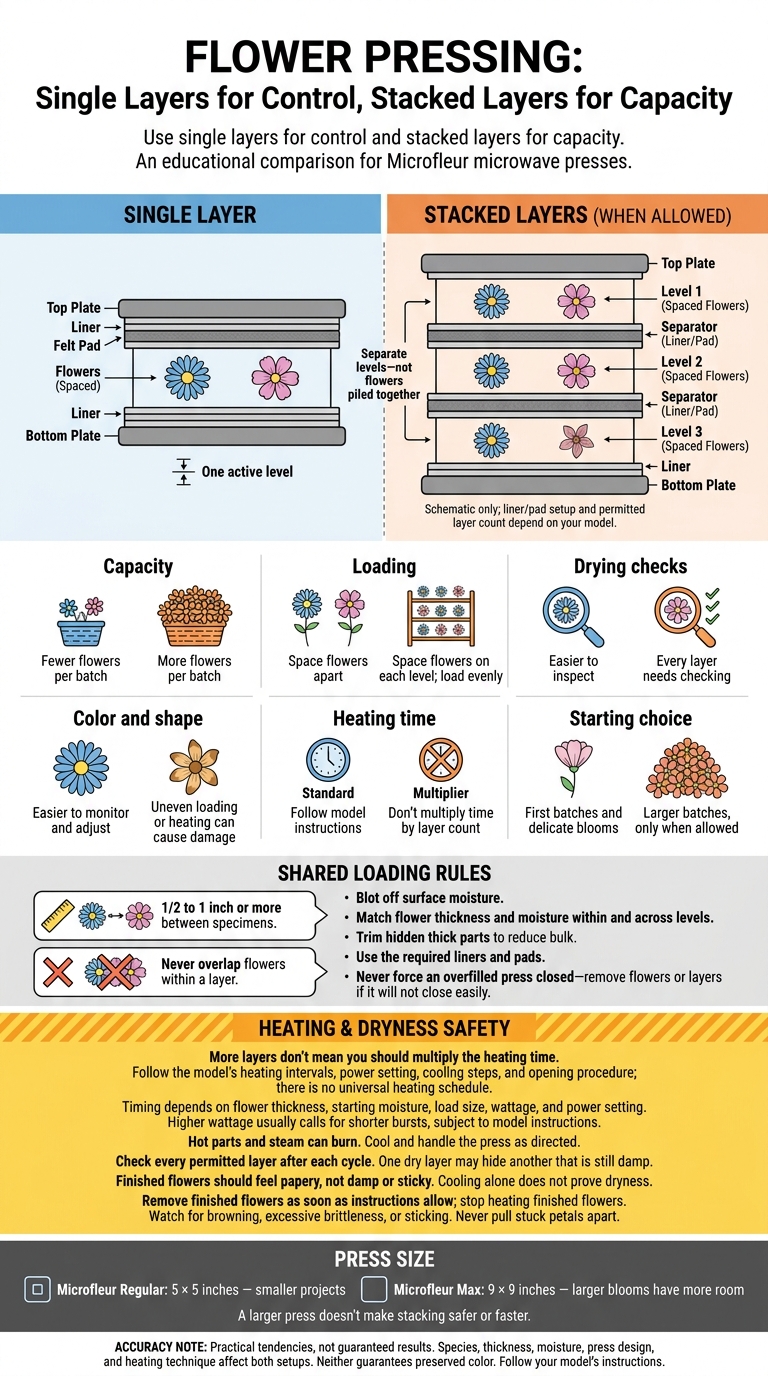
Single vs Stacked Flower Press Layers
How to Load Single and Stacked Layers
Single Layer: Space Flowers Apart
Place flowers face-down on the liner, leaving 1/2 to 1 inch or more between specimens so petals have room to spread during pressing. Gently open petals around each center. Use craft tweezers to adjust delicate petals and stems without damaging them. For tubular flowers, bell-shaped blooms, and unopened buds, flatten them closed to keep their side profile.
Blot off surface moisture before loading. Group flowers with similar thickness and moisture levels to help them dry evenly, and trim hidden thick parts to reduce bulk. Leaving space between blooms also helps them dry at a similar rate.
Stacked Layers: Use Separators and Load Evenly
Stacked layers are separate levels - not flowers piled together. They let you press more flowers at once, but give you less control over each bloom. Build every level with the required liners and felt pads so moisture can wick away and pressure stays even.
Spread flowers evenly across each level rather than crowding one corner. Keep thickness and moisture levels similar across all levels to avoid uneven drying.
The number of layers you can load depends on your liner and pad setup. Never force an overfilled press closed. If it won't close easily, remove some flowers or layers before heating.
sbb-itb-80d8183
How to Press Flowers in Minutes (Microwavable Flower Press Tutorial - Microfleur)
Single vs Stacked Layers: Results Compared
How you load the press affects how evenly flowers dry. Single and stacked layers differ most in drying control, color, shape, and the risk of heat damage.
These are practical tendencies, not guaranteed results. Species, thickness, moisture, press design, and heating technique affect both setups. Neither guarantees preserved color.
| Factor | Single layer | Stacked layers (when allowed) |
|---|---|---|
| Drying control and risk | Easier to inspect each flower and spot uneven drying | More layers to check, making uneven drying easier to miss |
| Color retention | Easier monitoring helps limit heat-related discoloration | Keeping color depends on avoiding unnecessary heating across every layer |
| Flower shape | Easier to position flowers, with less chance of wrinkling or curling | Uneven loading or shifting can distort petals or leave impressions |
| Time sensitivity and heat damage | Timing can be adjusted for one accessible layer, though overheating is still possible | More layers don't mean twice the drying time. Dry flowers can overheat while damp flowers still need more time |
The trade-off is clearest when comparing drying time, damage risk, and batch size: stacking increases capacity; single layers give you more control.
Thicker blooms need more drying time or thinning. Bulkier blooms may need to be split so their centers can dry.
For your first press, use a single layer. Start stacking only once you can judge dryness reliably, using single layers when precision matters and stacked layers when you need more volume.
Microwave Timing and Damage Prevention
Once the press is loaded, timing - not layer count - controls results. Drying time depends on flower thickness, starting moisture, load size, wattage, and power setting. Higher wattage usually calls for shorter bursts, so follow the press instructions rather than a fixed schedule.
Follow Heating Instructions and Check Every Layer
Follow the specified heating intervals, power setting, cooling steps, and opening procedure. Don’t multiply single-layer heating time by the number of layers or assume stacking cuts total processing time. Practice with less costly flowers while you learn the timing.
Between heating cycles, check moisture and follow the handling instructions. Hot parts and steam can burn, and an overheated press must cool before you handle it. Check every layer the instructions permit you to inspect after each cycle. Keep the fabric liners in place to protect flower shape, air the pads, and blot excess moisture as directed.
A single layer lets you see progress sooner. Stacked layers need closer attention to timing because heat and moisture can move unevenly through the press. One dry layer may hide another that’s still damp.
Check Flowers After Cooling
Cooling makes flowers easier to inspect, but it doesn’t prove they’re dry. After the cooling period, check both the petals and thick centers. Finished flowers should feel papery, not damp or sticky.
Remove finished flowers as soon as the instructions allow to avoid overheating them, especially if other stacked layers are still damp. Watch for browning, excessive brittleness, or sticking - signs that color and shape may be at risk. Never pull stuck petals apart. If the instructions allow it, gently stretch fabric liners in opposite directions to release them.
Conclusion: Choose Control or Capacity
Once you’ve worked out loading and timing, the choice comes down to control or capacity. Use single layers for control and stacked layers for capacity. Press size determines how much fits, but it doesn’t change the care needed when loading or heating.
Microfleur’s Regular (5 x 5 inches) suits smaller projects, while the Max (9 x 9 inches) gives larger blooms more room. A larger press doesn’t make stacking safer or faster. Follow your model’s instructions.
FAQs
How do I know if my press allows stacking?
Check your press model’s user manual before stacking. Designs and capabilities vary, so not every press allows it.
Microfleur microwave presses use a specific system of platens, pads, and liners. Follow the manufacturer’s guidelines for your equipment to get the best results and avoid damaging your flowers or the press.
Can I resume drying flowers after they cool?
Yes. For the best results, use short microwave intervals with resting periods. If the flowers still feel sticky or damp, repeat with more short bursts.
Let the press and flowers cool between sessions to help prevent burning and promote even drying. If needed, spread the drying process over several days.
How can I prevent stacked flowers from shifting?
Place each bloom face-down on an absorbent liner to help keep it from shifting in your Microfleur press. Add another absorbent liner between each layer of flowers to keep them separated and secure.
Leave 1/2 to 1 inch between blooms so they’re less likely to stick together or shift as they spread during pressing.





















