










I’d choose silicone for delicate resin jewelry and resin-safe plastic for simple, flat flower art. Silicone peels away from thin edges; plastic holds firm edges but needs more care during removal.
My rule: match the mold to the shape, then check its finish, resin compatibility, and heat limit. For UV resin, I’d use clear silicone that allows curing light through - and follow the resin’s instructions.
Quick Comparison
| What I check | Silicone | Resin-safe plastic |
|---|---|---|
| Best fit | Pendants, earrings, rings, and detailed shapes | Flat plaques, tiles, and geometric panels |
| Flexibility and release | Bends and peels away | Rigid or semi-rigid; may need release agent |
| Detail and finish | Handles deep details; glossy or matte surfaces transfer to resin | Handles detail, but undercuts can trap casts |
| Wear and heat | Dust and micro-tears can affect casts; check heat limits | Scratches can mark casts; heat may cause warping |
| Support | Large, flat molds need full base support | Firm walls hold shape; store fully supported |
Before pouring, I’d use fully dried flowers, check the resin’s maximum pour depth, and test a small cast. <u>Demolding time is not full-cure time.</u> For either mold, I’d avoid prying, use approved cleaning methods, dry it completely, and store it flat and covered.
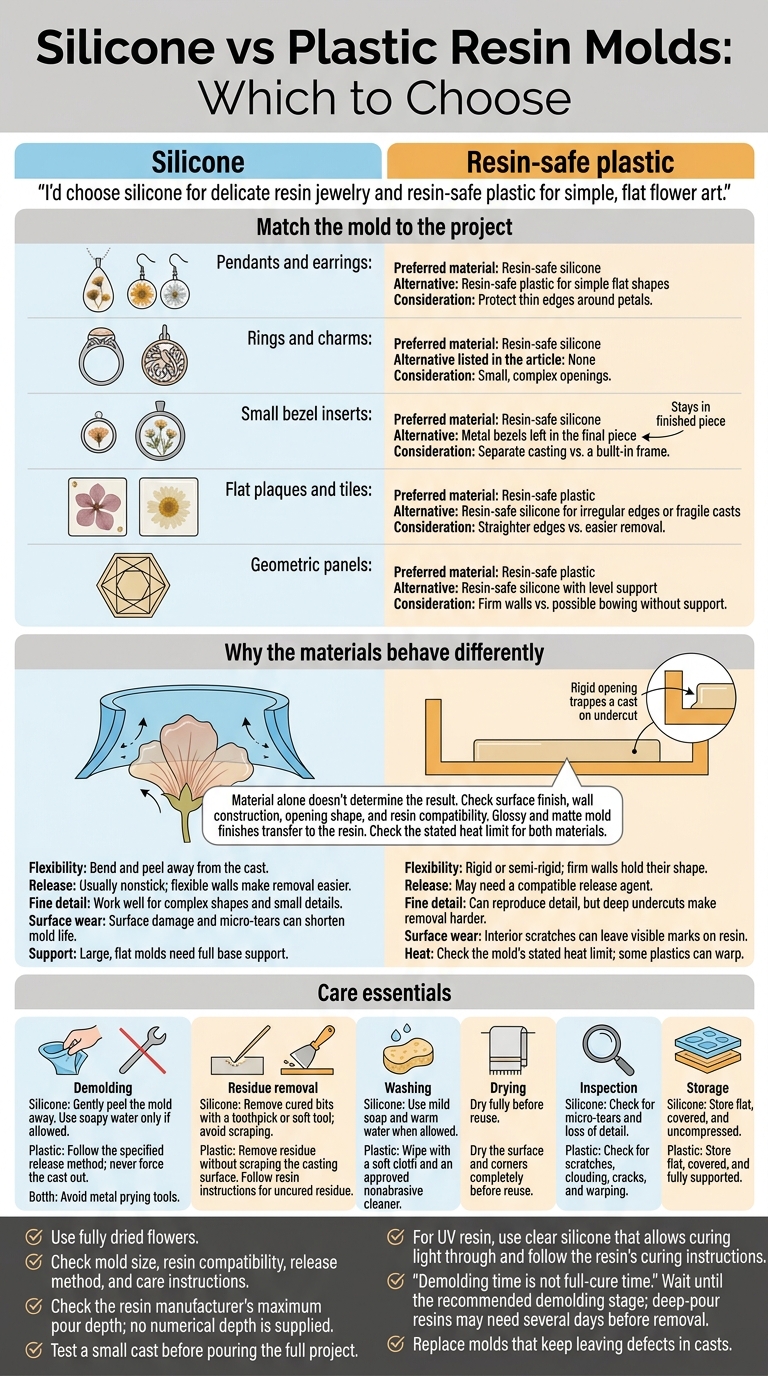
Silicone vs Plastic Resin Molds: Which to Choose
Silicone vs Plastic: Performance Compared
Material alone doesn’t determine the result. Look at the mold’s surface finish, wall construction, opening shape, and resin compatibility - not just whether it’s silicone or plastic.
| Feature | Silicone molds | Plastic molds rated for resin |
|---|---|---|
| Flexibility | Bend and peel away from the cast | Rigid or semi-rigid; firm walls hold their shape |
| Release | Usually nonstick; flexible walls make removal easier | May need a compatible release agent |
| Fine detail | Work well for complex shapes and small details | Can reproduce detail, but deep undercuts make removal harder |
| Scratch visibility | Surface damage and micro-tears can shorten mold life | Interior scratches can leave visible marks on resin |
| Heat limits | Check the mold’s stated heat limit | Check the mold’s stated heat limit; some plastics can warp |
The table offers a quick comparison. Here’s how those differences affect casting and mold care.
Silicone: Easy Release and Fine Detail
Silicone’s flexible walls let you peel the mold away from the cast instead of forcing thin resin edges through a rigid opening.
Check the surface finish before buying a customizable resin tray kit. Both glossy and matte finishes transfer to the resin, changing its final look. Silicone can also attract dust, while sharp tools can cause micro-tears that wear down the mold over time.
Plastic: Firm Walls and Surface Scratches
Plastic’s firm walls help the mold hold its shape, but they can make removal harder. Deep recesses and undercuts may trap the hardened cast.
Inspect the inside under good light before pouring. Scratches can leave marks on later casts. Heat from curing and unsuitable solvents can also damage plastic, so check the mold’s stated limits before reusing it.
sbb-itb-80d8183
Choosing Molds for Jewelry and Flat Art
Pressed flowers need a mold that releases cleanly and leaves a flat finish. Choose by project shape, not just mold material.
| Project | Preferred material | When the alternative works | Project-specific consideration |
|---|---|---|---|
| Pendants and earrings | Resin-safe silicone | Resin-safe plastic for simple flat shapes | Protect thin edges around petals |
| Rings and charms | Resin-safe silicone | None | Small, complex openings |
| Small bezel inserts | Resin-safe silicone | Metal bezels left in the final piece | Separate casting vs. a built-in frame |
| Flat plaques and tiles | Resin-safe plastic | Resin-safe silicone for irregular edges or fragile casts | Straighter edges vs. easier removal |
| Geometric panels | Resin-safe plastic | Resin-safe silicone with level support | Firm walls vs. possible bowing without support |
Pressed-Flower Jewelry: When to Use Silicone
For small pressed-flower pieces, flexibility matters most. Choose silicone for delicate jewelry, rounded shapes, and deep recesses. A metal jewelry bezel stays in the finished piece - it isn’t a removable mold.
Use fully dried flowers to reduce bubbles, browning, and cloudiness. If you’re using UV resin, follow its curing instructions.
Flat Flower Art: When to Use Plastic
For larger flat pieces, edge control matters more than flexibility. Plastic helps keep those edges straight, but scratches and release marks show easily on flat, clear pieces. Choose silicone for irregular edges, recessed details, or fragile casts.
Check depth, resin type, and support before pouring. Large, flat silicone molds need support across their entire base to prevent sagging and uneven thickness. Always check the resin manufacturer’s maximum pour depth.
Mold Care: Demolding, Cleaning, and Storage
Whether you choose silicone or plastic, how you care for the mold affects how long it releases casts cleanly.
Follow the instructions for both the mold and resin. Demolding time is not full-cure time, and deep-pour resins may need several days before you can remove the cast.
| Care step | Silicone molds | Plastic molds | Defects or damage prevented |
|---|---|---|---|
| Demolding | Gently peel the mold away. Use soapy water only if allowed. | Follow the specified release method; never force the cast out. | Broken edges, sticking, and tears |
| Residue removal | Remove cured bits with a toothpick or soft tool; avoid scraping. | Remove residue without scraping the casting surface. | Embedded debris and surface scratches |
| Washing | Use mild soap and warm water when allowed. | Wipe with a soft cloth and an approved nonabrasive cleaner. | Surface damage from harsh cleaners |
| Drying | Dry fully before reuse. | Dry the surface and corners completely before reuse. | Moisture-related bubbles and surface flaws |
| Inspection | Check for micro-tears and loss of detail. | Check for scratches, clouding, cracks, and warping. | Repeated defects and distorted casts |
| Storage | Store flat, covered, and uncompressed. | Store flat, covered, and fully supported. | Dust, creases, and distortion |
Demold Without Prying
Peel silicone away from the resin gradually instead of pulling on the cast. If it sticks, soapy water may help lubricate the contact area - but use it only if both the mold and resin instructions allow it.
For plastic molds, follow the specified release method rather than prying the cast out. With either material, avoid metal prying tools and wait until the recommended demolding stage.
Clean and Inspect Before Reuse
After demolding, remove residue before it hardens. Follow the resin instructions when handling uncured residue, and avoid abrasive pads, scraping, or unapproved solvents.
Dry the mold completely before pouring again. Even small water droplets can cause bubbles or surface imperfections.
Check the casting surface for micro-tears, scratches, clouding, cracks, and warping. Silicone micro-tears can grow during removal, while scratches or clouding in plastic can spoil a clear finish.
Store Molds Flat and Covered
Dry molds completely before storing them flat and covered, away from direct heat. Keep silicone uncompressed and give plastic molds full support. Replace molds that keep leaving defects in your casts.
Conclusion: Match the Mold to Your Project
Choose a mold that fits your piece’s shape and release needs. Silicone works well for delicate jewelry with fine detail. You can peel it away without putting stress on thin resin edges. Resin-safe plastic works for simple, flat shapes that release cleanly.
Before buying, check the mold’s size, resin compatibility, release method, and care instructions. Use clear silicone for UV resin jewelry. For deeper epoxy pours, check the mold’s listed depth and stay within the resin’s pour-depth limit.
FAQs
How can I tell if a plastic mold is resin-safe?
If you’re not sure whether a plastic mold is safe for resin, start with a small test pour. This lets you check compatibility before committing to a larger project.
Silicone molds are the industry standard for resin work. They flex, making it easier to remove finished pieces without damaging them. For UV resin, use clear molds so UV light can reach the resin from all sides for even, complete curing.
Will mold release affect my resin’s finish?
Yes - if you apply too much. A light mist helps your piece release and protects the silicone mold from micro-tears. Too much, though, can leave visible streaks. For a smooth, clear finish, use a thin layer rather than a heavy coating like cooking spray.
If your piece sticks during demolding, add a drop of soapy water along the edge to help it gently slide free.
Can dried flowers block UV resin from curing?
Dried flowers themselves don’t block UV light. But they need to be completely dry: trapped moisture can cause rot, discoloration, or curing failures.
The mold is the main factor in how much light reaches the resin. Clear silicone molds let UV light reach it from all sides for a complete cure. Colored or opaque molds can block the light, leaving the resin sticky or uncured.





















